


We just shipped whatareyoubuild.ing, a showcase where you submit the product you're building, put it in front of other builders, and get a free GEO review of how visible it is to AI search engines. The platform itself runs entirely on InsForge infrastructure.
Search is moving from links to answers
After launch, every developer hits the same problem: distribution. The channel that used to solve it, ranking in Google's ten blue links, is shrinking. ChatGPT, Gemini, Perplexity, Claude, and Copilot answer queries directly and cite a narrow set of sources, typically 2 to 7 domains per response. Most searches now end without a click on any result.
Getting cited in those answers is Generative Engine Optimization (GEO). It overlaps with SEO but optimizes for different signals:
| Traditional SEO | GEO | |
|---|---|---|
| Goal | Rank in the top 10 links | Get cited in synthesized answers |
| Input | Keyword phrases | Conversational prompts |
| Signals | Backlinks, keyword density | Citation authority, fact density, semantic relevance |
| Metric | Organic traffic, CTR | Visibility score, share of voice, citation count |
What AI engines evaluate
An engine decides whether to cite you in three stages: can it find your content, can it parse it, and will it pick you over a competitor. In practice that breaks down into four areas:
- Technical: AI crawlers like GPTBot, PerplexityBot, and Google-Extended aren't blocked in robots.txt; content is visible in raw HTML instead of behind JavaScript rendering; an llms.txt file gives crawlers a structured map of the site.
- Content: specific claims, numbers, and definitions instead of marketing copy; short focused blocks under clear H2/H3 headings that an engine can extract whole.
- Entity: JSON-LD schema with stable
@ididentifiers linking your brand, authors, and product; consistent naming across directories; presence in knowledge graphs like Wikidata. - Authority: mentions in third-party publications, transparent author bios, and original research worth citing.
Engines also weight these differently. ChatGPT favors recency and entity authority, Perplexity favors source diversity, and Gemini leans on classic Google ranking signals. AI citations decay faster than Google rankings too, so content needs regular refreshes to keep its spot.
How to optimize for AI search
Get the SEO fundamentals right
AI engines still lean on traditional ranking signals: Core Web Vitals (speed and visual stability), mobile optimization, HTTPS, a crawlable structure, and quality content. Audit regularly with Search Console, PageSpeed Insights, and Screaming Frog. Sites that rank well in classic SEO keep that edge in AI answers.
Optimize for conversational queries
| Traditional search | Conversational search | Content strategy |
|---|---|---|
| best restaurants NYC | what are the best restaurants in NYC for a romantic dinner under $100? | Build pages segmented by price and occasion |
| digital marketing tools | what digital marketing tools work best for small businesses on a limited budget? | Organize tools by company size and budget |
- Add question words (what, how, why) and context limits: audience, budget, timing, use case.
- Mine question-style keywords with AnswerThePublic and AlsoAsked.
Structure content for AI retrieval
Use descriptive H2/H3 headings, bulleted lists, comparison tables, FAQ blocks, short paragraphs, and bold for key points. Don't just rewrite your product page. Spin up separate pages around the questions users actually ask.
Show expertise and authority (E-E-A-T)
Flesh out author bios with credentials and real experience. Use first-hand examples and reliable data, cite credible research, show testimonials and industry certifications, and publish related content on authoritative platforms like an optimized LinkedIn profile or company page.
Keep content fresh
Audit every 3 to 6 months. Update stats, pricing, and industry trends, and don't just bump the date without changing the substance. Use Google Analytics and ContentKing to find high-traffic pages that need a refresh, and Google Trends to spot emerging topics.
Add structured data
Deploy schema for the content types that matter: Article, FAQ, HowTo, Recipe, LocalBusiness, Product, Review. Tools: Google's Structured Data Markup Helper, the Rich Results Test, and a JSON-LD generator. Start with FAQ and HowTo on your top ten pages by traffic.
Build a citation footprint across the web
AI training data leans heavily on public platforms, so multi-source signals carry real GEO weight. For example, reuse your product-page content and turn it into 3 LinkedIn posts, 5 Reddit answers, and 2 Medium articles, then distribute each to its platform.
The free GEO review
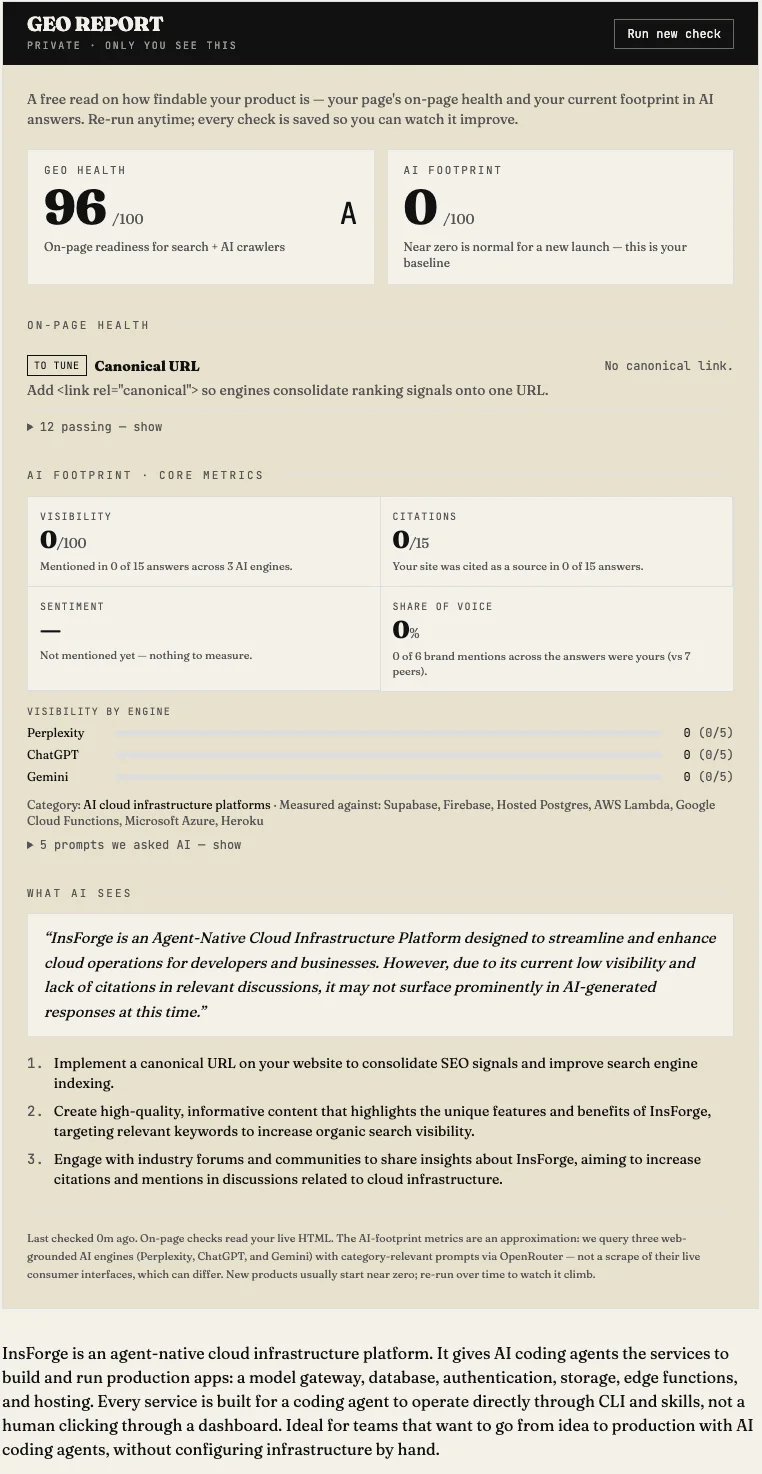
Every product submitted to whatareyoubuild.ing gets a free GEO report. It gives you two separate scores on purpose, because a brand-new product can have a perfect page and still be invisible to AI. Blending them into one number would hide that.
- GEO Health (0 to 100, graded A to F): deterministic on-page checks of what you can fix today. Each item is flagged URGENT, TO TUNE, or DONE, with what we found and a one-line fix: title, meta description, single H1, canonical,
<html lang>, Open Graph, Twitter Card, JSON-LD, favicon, whether robots.txt lets AI crawlers in, llms.txt, sitemap, and how much body text survives without JavaScript. - AI Footprint (0 to 100): your measured presence in AI answers. We infer your category and competitor set, generate 5 prompts a real user would ask, and run them against Perplexity, ChatGPT, and Gemini. 15 live probes per report.
From those probes the report scores the four core GEO metrics: Visibility (the share of answers that mention you), Source Citations (answers that list your domain as a source), Sentiment (how the AI talks about you when it does), and Share of Voice (your mentions versus you plus competitors), with a per-engine visibility breakdown so you can see where you're seen. The Footprint score weights Visibility at 50% and Citations and Share of Voice at 25% each. Sentiment stays a qualitative signal and doesn't enter the blend.
The report closes with coaching: how an AI would describe your product if someone asked today, and the top 3 changes that would move your scores. Every run is archived by date instead of overwritten, so you can watch your Health and Visibility climb as you ship fixes.
Get Started
We built whatareyoubuild.ing and its GEO Review tool out of our own work on product distribution, to help you get yours in front of more people. Want to go deeper? Join the #show-cases channel on our Discord.
- Log in at whatareyoubuild.ing and submit your product
- Build your own backend on InsForge
- Star us on GitHub
- Follow us on X (twitter)